





The success of any major development depends on securing the approvals, infrastructure and stakeholder confidence needed to deliver it.

Hyceon leads the master planning and permitting process through an integrated, design-led approach, aligning planning strategy with technical delivery from the outset.
By bringing together master planning, environmental and noise assessments, permitting and community engagement within a single multidisciplinary team, we create phased, buildable developments that reduce risk, accelerate delivery and provide a clear pathway into detailed design.
How we deliver it
Our 4-Step Permitting Framework
Understand the client, the site and the constraints
We start from the project you need to deliver and the site’s jurisdictional, environmental and community context — mapping every permit, assessment and agreement the project will need.
Fix the master plan and the approval route
Strategic campus design and the fastest robust approval pathway developed together, so the plan submitted for approval is the plan that will be built.
Prepare, assess and engage
Environmental Impact Assessment and technical studies, application documentation and stakeholder engagement prepared in parallel, with design and engineering input resolving objections before they arise.
Secure approvals and hand over to design
Application management, hearings and negotiation through to approval — with conditions tracked into the design and delivery stages so permits convert to energised capacity.
What We Deliver
Campus master planning
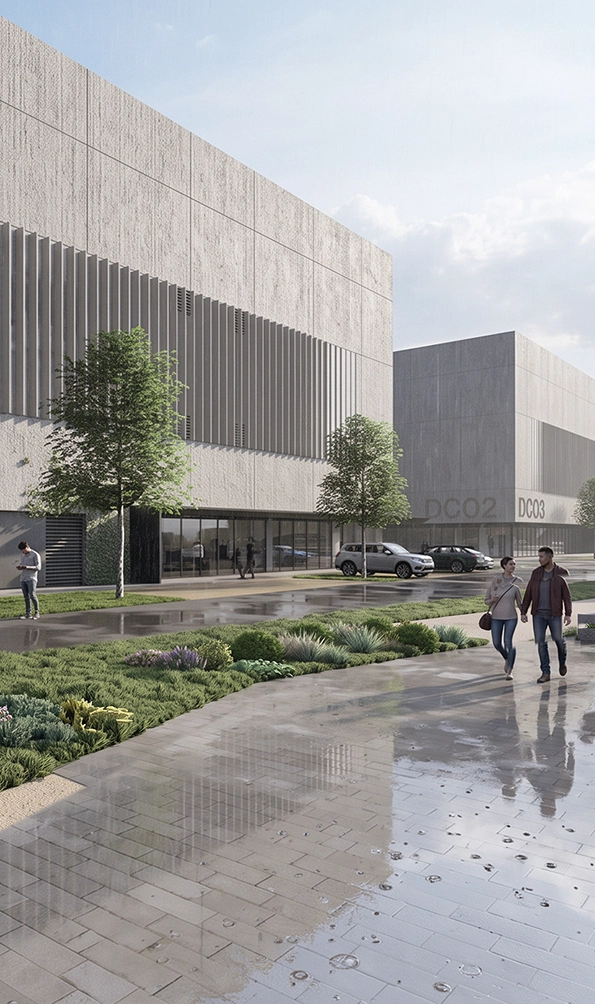
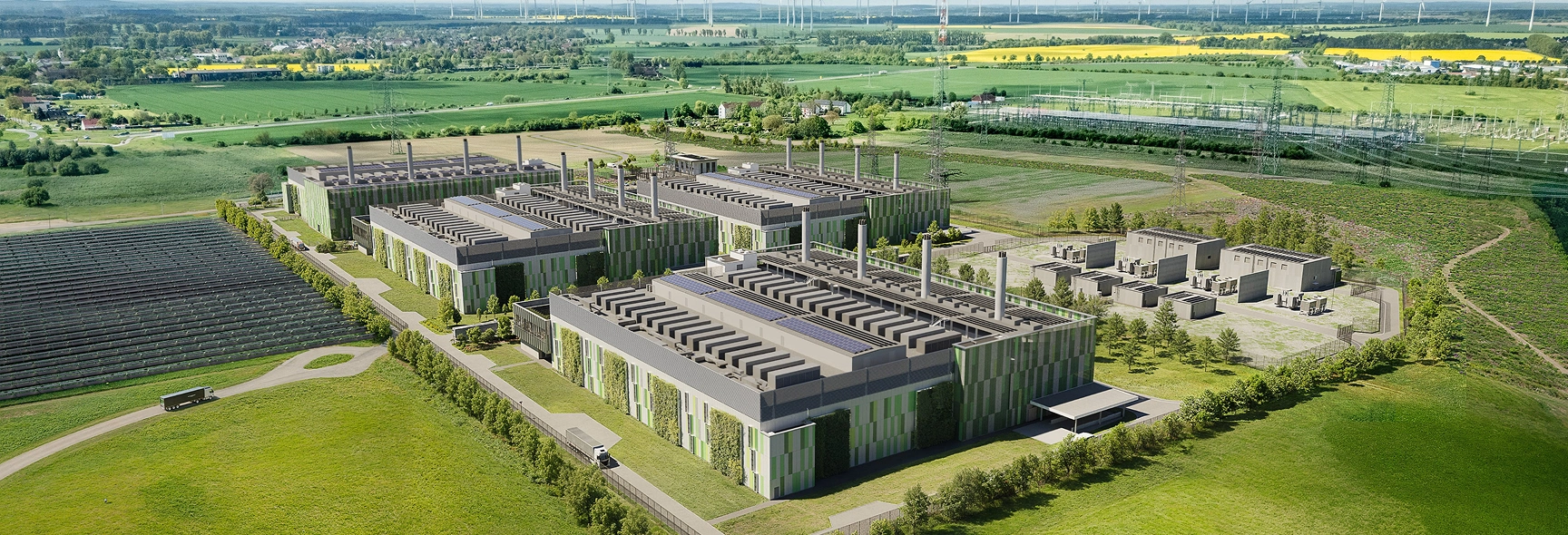
Land-use, phasing, utility corridors, landscape strategy and infrastructure frameworks for hyperscale and multi-building campuses, designed for decade-scale expansion — the strategic design work that gets the project permitted.
Permitting strategy & authority engagement

Permitting roadmaps, pre-application engagement, application management and negotiation with planning and technical authorities.
Planning applications & zoning strategy

Zoning and entitlement strategy, planning applications and land-use change management across European jurisdictions.
Environmental Impact Assessment (EIA) & specialist emissions studies

Environmental Impact Assessment, national emissions-control permitting (for example BImSchG in Germany), air quality and ecology studies, and environmental and socio-economic development studies.
Safety & major-accident assessments

Major-accident safety concepts (for example Seveso), hazardous-substance storage concepts and water/wastewater permitting aligned with facility design.
Noise & acoustic assessments

Noise emission calculation, vibration and room-acoustics studies, noise reports for building permit applications, and acoustic measurement and verification.
Utility & grid connection agreements

Grid application strategy, connection negotiations and coordination of power, water and fibre agreements alongside permits.
Community engagement & social licence

Stakeholder mapping, consultation, public inquiry representation, and community benefit and give-back initiatives that build durable local acceptance.
Multi-jurisdiction approval management & operational compliance

Coordinated permitting across countries and municipalities for multi-site portfolios — and ongoing operational environmental compliance, reporting and environmental-officer services once the facility is live.

Why Hyceon?
Master planning under one roof
Land-use, landscape, utilities and permitting shaped together — the master plan submitted for approval is the master plan that carries the project.
Permitting-led development
Approval strategy shaped by our own design and engineering teams — planning risk engineered out from day one.
Regulatory depth, local language
Hundreds of permits secured across European jurisdictions — teams working in the instruments of each market, from EIA screening to national frameworks such as Germany’s BImSchG.
100
Get support with your next approval
Frequently Asked Questions

In most European markets, grid connection and planning approval — not construction — set the critical path. A refused or delayed application can strand land and capital for years. Permitting-led strategy, started at feasibility, converts regulatory complexity into a managed workstream with predictable milestones.
From under six months for permitted-use sites to several years where rezoning, full EIA or public inquiry is required. Timelines vary sharply by country and municipality. Early pre-application engagement, correctly scoped assessments and complete first-time submissions are the strongest levers for compressing the timeline.
Every European market has its own environmental permitting instruments; Germany’s is among the most significant for data centres. The Bundes-Immissionsschutzgesetz (BImSchG) governs environmental impacts from technical installations — including noise and exhaust from backup power plants — and can require a dedicated permit alongside the building permit, often determining generator configuration, acoustic design and stack requirements.
Master planning fixes the strategic framework of the campus — land use, phasing, utility corridors, landscape strategy, infrastructure logic — the plan that gets permitted. Architecture picks up after master planning approval to design the buildings themselves and take design authority for all trades. They are consecutive stages of the same conversation, run by the same integrated team.
Design that anticipates objections — sensitive massing, quiet plant, landscape and traffic strategy — combined with genuine community benefit: heat reuse, local employment, public realm improvements. Meaningful engagement started before applications are filed, not after, is the single strongest predictor of durable local support.
Yes. The same permitting disciplines — EIA, environmental assessment, community engagement, multi-jurisdiction management — apply to pharmaceutical, healthcare and industrial mission-critical projects across our European markets.